This is the first of a series of posts on a number of issues concerning English Language Teaching at secondary school level. The discussions will be prompted by my reading of chapters from
Tricia Hedge's Teaching and Learning in the Language Classroom.
The first chapter,
'Learners and Learning, Classrooms and Contexts', addresses, among others, a key issue for language teachers and learners:
motivation for learning. Today, I'm reviewing two English coursebooks to explore some of the motivations they give for learning English, both explicitly as set out in their aims, and implicitly, such as in their contents. In other words, I'll try to answer: how can a textbook be motivating?
'Challenges', by Michael Harris & David Mower, Pearson Longman 2006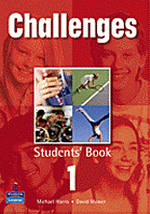

- The 'informative and engaging topics'. Indeed, the authors have tried to cater for a variety of topics which are age-specific and are meant to involve adolescents and arouse their interest. The topics are generally those that teens find appealing: their lives and interests - sports, hobbies, outings, television, films, teenage concerns (bulling), music, technology, styles, mysteries, etc. Work in all four skills is contextualised in relevant situations which students can relate to and identify with.
- As regards the learning of the form of the language, the authors have provided 'strong grammar and skills sections to give students confidence in using the language'. Students first see how grammar works in context, which will make the grammar section and the practice more memorable. 'Grammar boxes' to complete, word building sections, etc, can promote discovery learning and help students organise the language. This guidance can assist them in their developing ability to analyse grammar and engage them in more analytical thinking, which is a key step for a secondary school student.
- A 'magazine' at the back of the book with puzzles and quizzes further caters for fast finishers, mixed ability classes, and brings more variety to class work. Its format resembles indeed that of a teen magazine, with lots of quick and fun features which are visually stimulating and often food for thought.
- As explained by Hedge in her book, 'variety of input, pace, intensity, activity and interaction' is fundamental to promote students' motivation. In any given lesson of Challenges, students can move from a whole-class light-hearted discussion to more intensive reading, to demanding grammar focus, to contextualised and meaningful grammar practice, to pair work, and so on.
- To add to the variety of classroom work, the Teacher's Resource Pack comes with several photocopiables activities which involve different forms of interaction, skills practice and demand varied classroom dynamics (pair, group, or whole class work. Communicative tasks try to provide an element of fun to engage learners in achieving a certain goal.
'New English File', by Clive Oxenden and Christina Latham-Koenig, Oxford, 2004-2009

- Careful thought has been given to contextualise skills work in 'topics that will arouse students' interest' and in 'engaging and stimulating texts'. For example, famous people and films, holidays and hotels, daily routines, free time, etc. are all themes which can make adults willing to discuss and get them into lively conversation.
- New English File also conveys the assumption that variety of input, activity and interaction is key in sustaining students' motivation and helping create a smooth pace throughout a given lesson. When looking at any lesson page, we also find that language forms are learned in a context and always with a communicative purpose. Emphasis has been given to provide skills practice intended to trigger students to share their opinions and to arouse their interest.
- Hedge that an important role for the teacher is to 'create successful experiences which will enhance motivation'. New English Files supports the teacher and learners in this aspect, as in the case of speaking tasks, which are generally 'achievable' and move progressively towards less guidance.
- 'Practical English' lessons give students practice in typical, realistic, situations with an emphasis on 'how to survive' strategies. This really brings out the 'instrumental' dimension of motivation, the one learners are often largely interested in. Performing a role gives learners the chance to imagine how they would 'live' a situation. I've seen students get really motivated by the challenge. The accompanying DVD for these lessons often makes the situation and characters 'come alive' in amusing and entertaining scenes.
- More communicative activities in the Teacher's Book provide more variety of interaction and activity to the lesson, helping learners consolidate the language learned.
- The accompanying MultiROM and student's website provide further practice, assist learners in more autonomous learning and motivate them to work at their own pace, generating more confidence and personal achievement in individual learners.
All in all, I've been trying to examine some of the most salient features of these two widely acknowledged coursebooks. Both of them do have features which make them a real progress from books which were used twenty years ago, when the communicative classroom was just starting to take shape. Of course, no book is (or will ever be?) the philosopher's stone of English teaching, because no writer - no teacher and no student, for that matter - is perfect. A book is just
one more element that makes up the whole of a teaching-learning situation. It should be one of the many ways to support their learning, the teacher's and learners' collaborative work being the central one, in my view. It can be of great help to motivate our students to learn English - or not... However,
we teachers can make it motivating in our everyday use of it: when we plan it, adapt it, add things to it, omit things, when we teach our students how to use it and profit from it... And also
our learners themselves can make it motivating, depending on their own needs and interests: I have taught the same pages from the same book to different classes with very different results! Perhaps something to keep in mind is what many teachers I know believe in :
'We teach our students, not the book.' If used in this way, a book can be really motivating.
 Please be sure to bring your books!